

Smart cash management,
simplified.
Ampersand makes it easy to protect, optimize, and manage large cash balances without the complexity of opening and overseeing multiple bank accounts. From onboarding to ongoing monitoring, we handle the details.
Where your cash goes —
and how it comes back.
Fund one account from your operating bank. Ampersand, as your administrator, places it across insured institutions. Interest rolls up to one statement — and when you need cash back, it settles to your operating bank.
Four steps.
One relationship.
Select a step to see what happens and what you do.
Easy onboarding
Getting started with Ampersand is straightforward.
Fund one account
Once onboarded, you fund a single Ampersand account.
Ongoing monitoring
Ampersand monitors your deposits so no account exceeds $250,000 at any single institution.
One view. One statement.
Despite being distributed across multiple institutions, your experience stays simple.
Easy onboarding
Changing banks is a hassle — and with Ampersand you don’t have to. Our onboarding process is streamlined, with limited paperwork and clear, step-by-step guidance. And you’re never on your own. Our experienced client service team is available throughout the process to answer questions and help ensure everything is set up correctly from day one.
- One agreement — Ampersand acts as your administrator
- Accounts titled to support pass-through coverage in your name
- No need to change banks — keep your operating accounts with your community bank
- Dedicated client service contact
What happens to $5M?
One wire or ACH from your operating account to your Ampersand account.
Broken into whatever increments are needed for your rate and coverage — e.g. 20 × $250,000 — titled for pass-through coverage in your name.
Each deposit is kept within the standard FDIC/NCUA limit at that institution.
Total balance, interest and coverage — in one portal and one 1099-INT.
Illustration only. Even $250,000 increments are shown for simplicity and are not indicative of how any account will actually be allocated. Funds are broken up into whatever increments are necessary to seek your rate and coverage objectives, which may be smaller than $250,000 and vary by institution, and the number of institutions used may differ. Assumes a single depositor and ownership category with no other deposits at those institutions. Coverage above standard limits depends on the number of participating institutions and satisfaction of pass-through requirements.
One view. One statement.
Full transparency.
Though your deposits are spread across many institutions, you log in once. See balances by institution, liquid and CD positions, interest, insured coverage and every request — in one place.
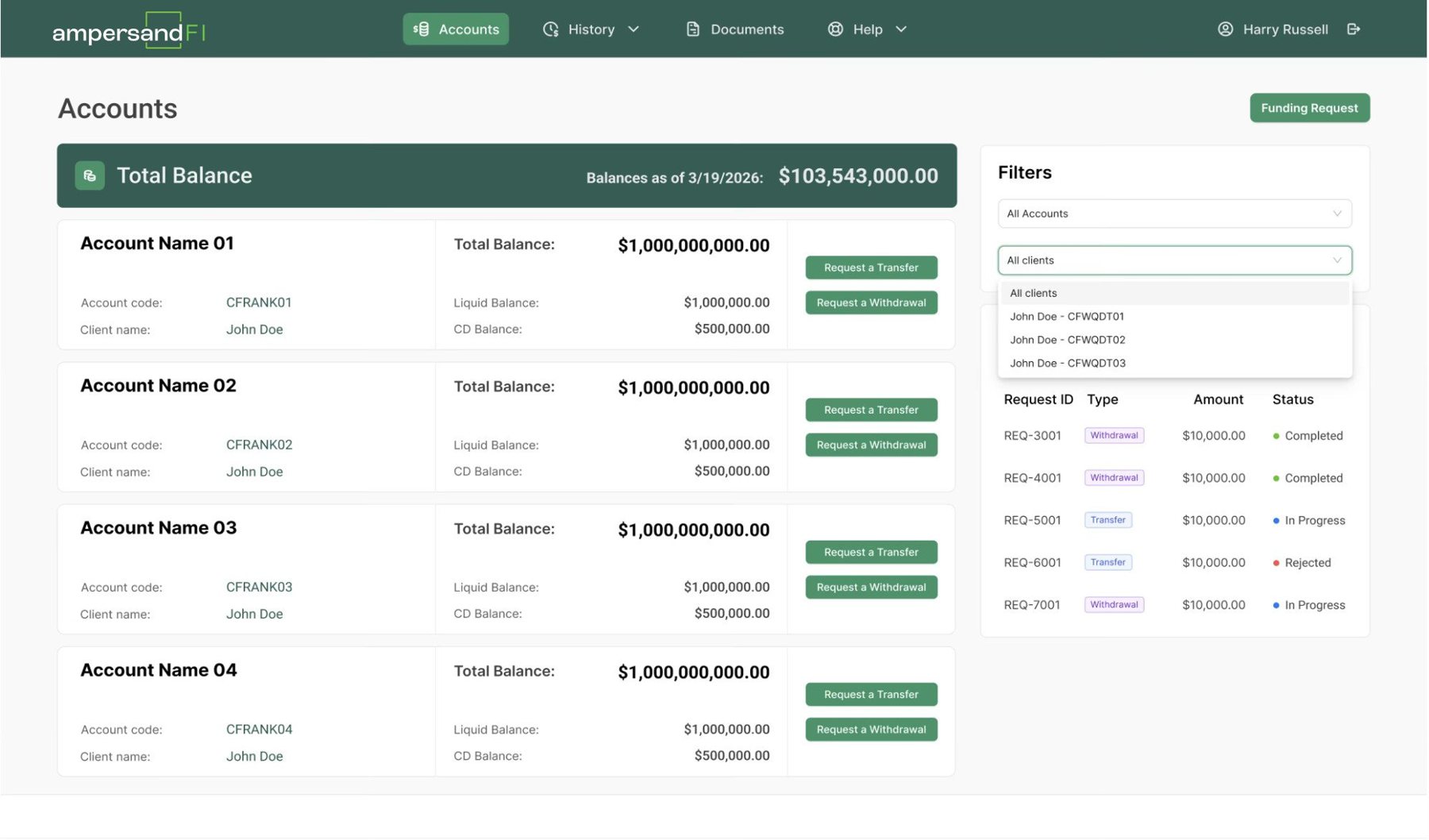
Portal screenshot shows sample data. Features may vary by account type and are subject to program terms.
Fair questions.
Straight answers.
Higher rates and broader protection can sound like a catch. Our FAQ answers the hard questions — who holds your money, who insures it, how rates can be higher, and what the catch is.
Ampersand, Inc. is not a bank or depository institution. Ampersand acts as administrator for clients in placing deposits at FDIC- or NCUA-insured banks or credit unions within the Ampersand partner network. Applicable deposit insurance is provided by those institutions, subject to standard limits, aggregation rules, and regulatory requirements, including conditions for pass-through coverage. Coverage in excess of the standard insurance limit at a single institution is achieved by allocating funds across multiple insured institutions. Interest earned may be held in your Ampersand high-yield account or, at your election, sent to your operating bank, subject to program terms and processing times. ‡ Ampersand program rates have averaged 5–9x the FDIC national average savings rate. Comparison is based on publicly available FDIC national average rates for similar deposit products (Source: fdic.gov/national-rates-and-rate-caps) versus rates provided by participating financial institutions in the Ampersand program, as of 10/15/2026. Averages are not a guarantee of any individual client’s rate; actual rates vary by deposit size, product structure, term, market conditions and participating institutions, and are subject to change. Past performance is not indicative of future results. Rates, terms, and access to funds may change and are not guaranteed. Monitoring of partner institutions does not guarantee their financial condition. Full disclosures →
Ready to see how it works
in practice?
We’ll walk through a sample allocation for your balance and answer questions about coverage, liquidity and reporting.